
English| EUR
Suggested for you
More currencies
Choose a language
Egypt's chalk desert looks close on a map and behaves like a long-haul day on the road. This how far is the white desert from cairo guide sets out the road distance, the realistic drive time, and the point where asphalt gives way to soft sand. It also flags what that distance means for anyone weighing a single day against an overnight camp.
Quick answer
The White Desert lies roughly 500 km (about 310 miles) southwest of Cairo, a drive of five to six hours via the Bahariya and Farafra oases. The park itself never closes — access runs 00:00–23:59 daily — but arriving between 06:00 and 18:00 avoids extreme heat, and the final approach across soft sand requires a 4x4.
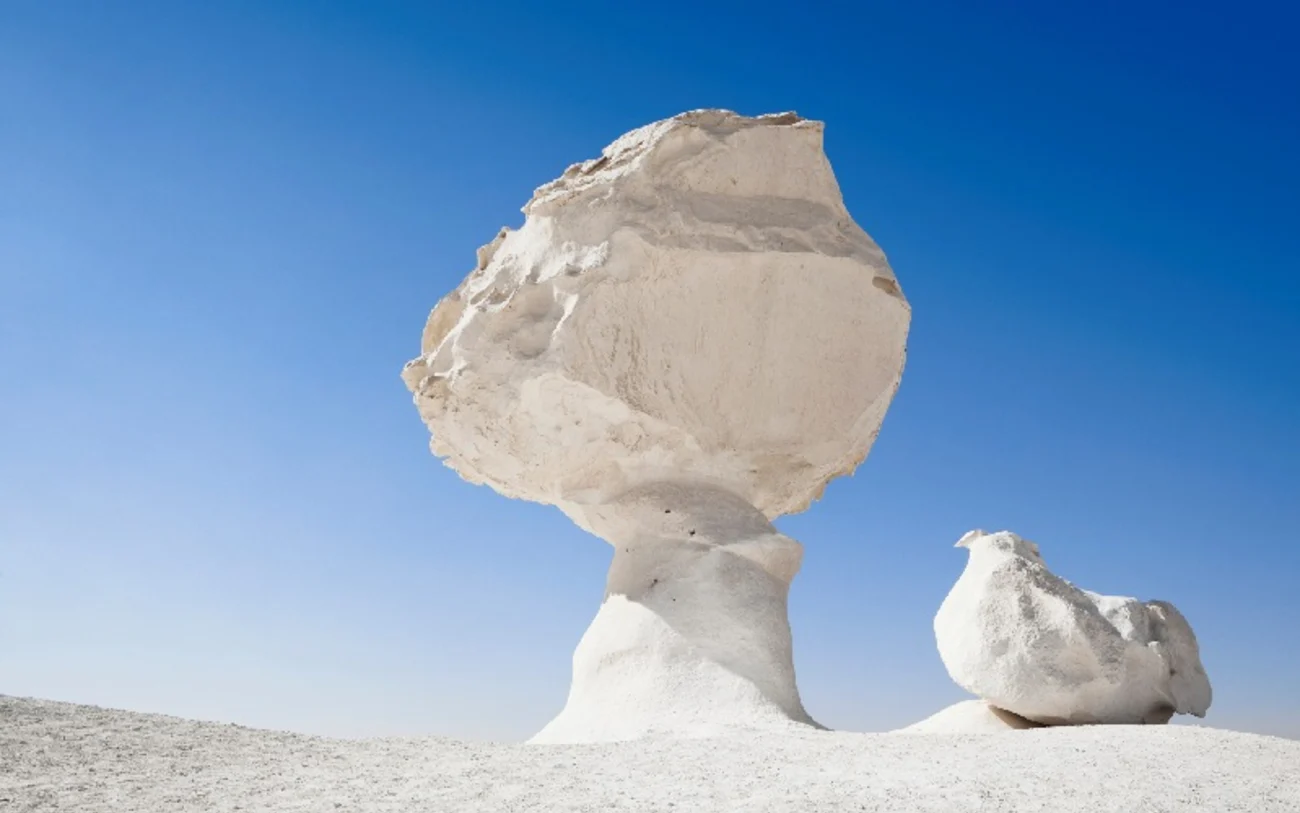
The chalk towers of the White Desert are the eroded floor of a sea that covered this part of North Africa some 80 million years ago. What reads as sculpture is compressed plankton, carved since by wind rather than water. That geology explains the journey. The formations sit deep inside the Western Desert, in New Valley Governorate, not on Cairo's doorstep. The practical question follows: how far is the white desert from cairo, and how much of a day the road consumes. What lies between the capital and the chalk matters as much as the number itself. The corridor runs southwest through the Bahariya depression, then on toward Farafra Oasis. Bahariya is the halfway marker and the place most itineraries pause. Beyond it the ground changes twice. First come the basalt-strewn cones of the Black Desert, dark and volcanic. Then Crystal Mountain, a low calcite ridge that convoys stop at briefly. Only after that does the white chalk begin, opening into the mushroom rocks and inselbergs of Agabat. A standard White Desert tour from Cairo threads all three landscapes into one run, which is why operators leave before dawn. Distance also decides the shape of the trip. A return in a single day is possible and punishing. Most visitors instead camp overnight among the formations, where the temperature drops sharply after dark and the Milky Way is visible without optics. The last stretch into the protected area is unsealed. Licensed 4x4 vehicles and a registered guide are standard rather than optional, and ordinary hire cars are turned back at the sand. Readers who arrive asking how far is the white desert from cairo usually leave with a second question: whether Sahara el Beyda is a long excursion or a short expedition. The honest answer is the latter. Two days is the sensible budget, with the drive treated as part of the itinerary rather than an obstacle to it. Before fixing a date, check the dedicated sections on this page for the conservation fee, the arrival window and the seasonal timing — those details, not the kilometres, are what most often reshape a plan.
“The White Desert is not a day trip that happens to be long; it is a short expedition that happens to start in Cairo.”
The White Desert National Park is located approximately 500 kilometers southwest of Cairo in the New Valley Governorate. The journey requires a drive through the Western Desert, typically starting via the Cairo-Bahariya Oasis highway.
Cairo to Bahariya Oasis via Route 22
Bahariya Oasis to White Desert National Park
Required for off-road navigation within the park
Travelers must utilize a 4x4 vehicle for the final leg of the journey, as standard vehicles cannot traverse the desert terrain. It is recommended to coordinate with a local guide who is familiar with the route to the White Desert National Park.
The period between October and April offers the most manageable weather for visiting the White Desert. Arriving within the optimal window of 06:00–18:00 ensures you avoid peak heat while securing sufficient time for camp setup before sunset.
Cooler days, cold desert nights
Ideal for comfortable exploration and overnight camping.
High heat, 35°C to 45°C
Extreme temperatures make daytime activities difficult.
—
Arriving between 06:00–18:00 balances temperature control and setup requirements.
Verdict: The best time to visit is from October to April, aiming for arrival between 06:00 and 18:00 to optimize comfort and visibility.
The White Desert National Park remains accessible to visitors throughout the entire week, operating on a twenty-four-hour schedule. This continuous availability facilitates travel planning for those arriving from Cairo.
Preparation for the White Desert falls into three buckets — permits and paperwork, water and gear, and timing your arrival — and most of it has to be settled before you leave Cairo.
Everything you need to know about how far is the white desert from cairo
The distance between the capital and the national park is approximately 500 kilometers. Most travelers find that knowing how far is the white desert from cairo is the first step in planning their desert expedition.
Many visitors book a professional Cairo White Desert tour to navigate the remote Farafra depression safely. These excursions typically include 4x4 vehicles suitable for the rugged terrain.
Driving from the city usually takes between 5 to 7 hours depending on the route and traffic conditions. You should account for this travel time when considering how far is the white desert from cairo for your itinerary.
The best arrival window is between 06:00 and 18:00 to avoid extreme heat. This timing also allows visitors to prepare their campsite before the sun sets over the limestone formations.
The official conservation fee is 100 EGP per person for entry into the protected area. Please ensure you have local currency available as this fee is mandatory for all visitors.
Driving a private vehicle remains the most common way to reach the site. Calculating how far is the white desert from cairo helps in coordinating fuel stops and necessary supplies.
Due to the significant distance, a day trip is generally not recommended as it leaves little time for exploration. Most itineraries allocate at least two days to fully experience the landscape.
When planning your transit, remember that how far is the white desert from cairo requires careful logistical coordination. Reliable off-road transport is essential for navigating the Western Desert safely.
The park is a protected natural area with minimal infrastructure and no formal facilities. Travelers must bring sufficient water, food, and camping equipment for their stay.
Public transport options are limited and often require multiple transfers, making them impractical for most tourists. Private arrangements are the standard method to bridge the gap between the city and the desert.